
How Much Office Furniture Do You Need? A Guide by Employee Count
Furnishing an office can be challenging when you are not sure how much furniture you actually need.
How many desks should you buy? How many office chairs? Do you need a conference room? How much storage should you have? Should every employee have an individual desk, or would shared workstations make better use of your space?
The answers depend on more than just the number of employees.
Your office size, layout, work environment, employee roles, storage requirements, meeting needs, and plans for future growth should all be considered before purchasing furniture.
Whether you are opening a new business, moving into a larger office, downsizing, or replacing outdated furniture, this guide will help you estimate your office furniture needs based on the size of your team.
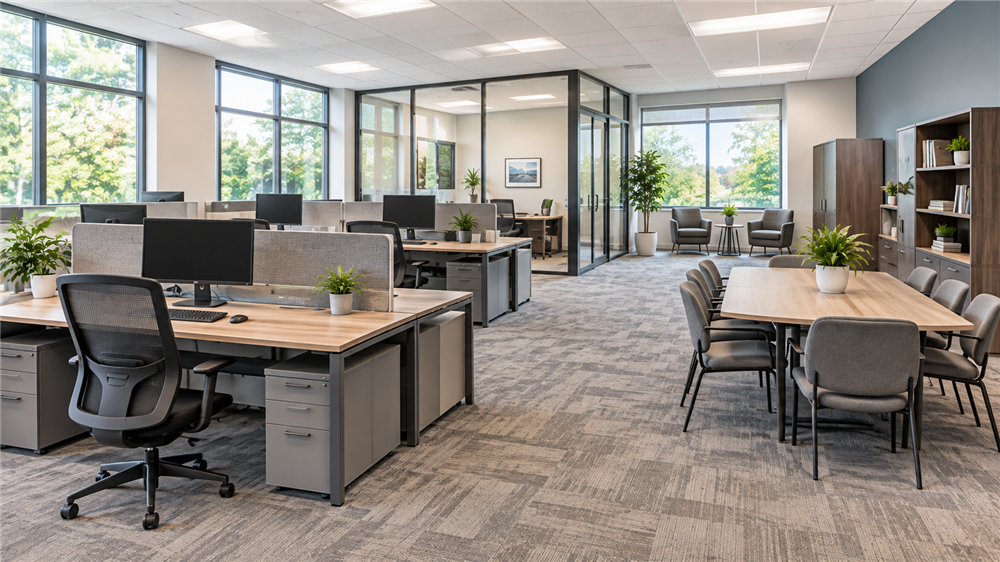
Start With Your Employee Count
The number of people working in your office is the best starting point for determining how much furniture you need.
However, you should not automatically assume that one employee equals one traditional desk.
Some businesses use private offices. Others use open workstations, shared desks, benching systems, or multi-person workstations.
Start by determining:
-
How many employees need a dedicated workspace
-
How many employees work remotely or have hybrid schedules
-
Which employees need private offices
-
Which employees can share workstations
-
How many managers or executives need larger desks
-
How many employees need specialized equipment
-
How often employees collaborate
-
How many visitors or customers typically come into the office
Once you understand how your employees use the space, you can start determining the right furniture mix.
Office Furniture for 1–5 Employees
A small office with one to five employees does not necessarily require a large furniture investment.
A typical small office may need:
-
1–5 desks or workstations
-
1 office chair per employee
-
Filing or storage cabinets
-
A small meeting table or conference table
-
Guest seating when needed
-
Reception furniture if customers regularly visit
For a very small business, individual desks may be the simplest solution.
L-shaped desks can also be useful when employees need additional workspace without requiring a separate room. They can make efficient use of corners while providing additional surface area.
If space is limited, avoid purchasing oversized furniture simply because you have room for it. Leave enough open space for employees to move comfortably around the office.
If you are furnishing a small business, our guide on office furniture for small businesses provides additional ideas for making the most of limited space.
Office Furniture for 6–10 Employees
Once your business reaches six to ten employees, office planning becomes more important.
You may need:
-
6–10 employee workstations
-
6–10 office chairs
-
One or more private offices
-
Shared storage
-
Filing cabinets
-
A conference table and chairs
-
Reception furniture
-
A small collaboration area
This is also a good size office to consider modular workstations or shared workstation configurations.
Instead of giving every employee a large individual desk, you may be able to use workstation systems that provide employees with their own work areas while making better use of the available floor space.
Your conference area does not necessarily need to be large. Choose a table and seating arrangement based on the number of people who typically attend meetings rather than the largest meeting you might have once a year.
Office Furniture for 11–25 Employees
At 11–25 employees, the office typically requires more careful planning.
A growing business may need a combination of:
-
Employee workstations
-
Private offices
-
Executive or manager desks
-
Ergonomic office chairs
-
Filing and storage cabinets
-
Conference room furniture
-
Reception furniture
-
Collaboration areas
-
Breakroom furniture
This is also where a professional office layout can make a significant difference.
Instead of simply placing desks wherever they fit, consider how different departments work together.
Employees who frequently collaborate may benefit from being located near one another. Employees who need concentration or privacy may benefit from more separation.
You should also consider how employees move between workstations, conference rooms, storage, reception, and other areas.
Our guide on how to plan an office layout can help you think through traffic flow, work areas, storage, and other important parts of your workspace.
Office Furniture for 26–50 Employees
Once your office reaches 26–50 employees, a detailed furniture plan becomes increasingly valuable.
A larger office may include:
-
Multiple workstation areas
-
Private offices
-
Executive offices
-
Multiple meeting spaces
-
Conference rooms
-
Reception and waiting areas
-
Shared storage
-
Filing areas
-
Collaboration spaces
-
Break areas
-
Training areas
At this size, modular furniture systems can provide flexibility.
If your business expects to grow, choose furniture that can potentially be reconfigured or expanded rather than creating a layout that only works for today's employee count.
You should also think about how departments may change over time.
A workstation configuration that works for 30 employees may need to be expanded when you reach 40 or 50 employees.
Office Furniture for 50+ Employees
Large offices require more than simply multiplying the number of desks by the number of employees.
At this size, space planning becomes a major part of the furniture project.
You may need:
-
Multiple workstation configurations
-
Private offices
-
Executive offices
-
Conference rooms
-
Training rooms
-
Collaboration areas
-
Reception furniture
-
Waiting areas
-
Storage areas
-
Filing systems
-
Breakroom furniture
-
Employee gathering areas
Large offices can also benefit from standardized furniture configurations.
Using compatible workstation systems, desks, storage, and seating can make future expansion and reconfiguration easier.
At this size, office space planning can help ensure that the furniture, workflow, traffic patterns, and available floor space work together.
How Many Desks Do You Actually Need?
The number of desks you need depends on how your employees work.
If every employee works in the office full-time and requires a dedicated workspace, you may need approximately one primary workstation per employee.
But that isn't the only option.
Businesses with hybrid employees may be able to use shared workstations or hoteling areas.
Other businesses may use:
-
Shared desks
-
Bench-style workstations
-
Two-person workstations
-
Three-person workstations
-
Modular cubicles
-
Open workstations
The goal is not simply to maximize the number of desks.
The goal is to provide enough functional workspaces without making the office overcrowded.
If you are comparing different desk options, take a look at our selection of office desks to see the different configurations available for commercial workspaces.
How Many Office Chairs Do You Need?
Office chairs are one of the easiest furniture requirements to estimate.
If each employee has a dedicated workstation, plan on one primary office chair per employee.
However, you may need additional seating for:
-
Conference rooms
-
Reception areas
-
Guest offices
-
Training rooms
-
Collaboration areas
-
Waiting areas
Employee chairs should also be selected based on how they will be used.
Employees who spend most of the day at a computer may benefit from ergonomic task chairs with adjustable features.
Conference rooms may require different seating than individual workstations.
Reception areas may need guest chairs designed for shorter periods of use.
You can explore different types of office chairs based on the needs of your employees and workspace.
How Much Storage Do You Need?
Storage requirements vary considerably from business to business.
A company that relies heavily on paper records may need considerably more filing space than a business that operates mostly digitally.
Consider:
-
Filing cabinets
-
Lateral files
-
Vertical files
-
Storage cabinets
-
Bookcases
-
Credenzas
-
Hutches
-
Supply storage
-
Personal employee storage
Don't automatically give every employee a separate filing cabinet.
Shared storage can often be more efficient, especially when several employees access the same files or supplies.
Also consider security. Documents containing confidential business information may require locking storage.
If you need to add or replace storage, explore our office filing and storage cabinets for options that can help organize a commercial workspace.
How Big Should Your Conference Room Be?
Your conference room should be based on how your business actually holds meetings.
Think about the number of people who typically attend.
Small meetings: A compact table with seating for four to six people may be enough.
Medium meetings: Businesses with regular team meetings may need seating for six to ten people.
Large meetings: Companies that regularly hold meetings with larger groups may need a larger conference table and additional room around it.
Don't size your conference room around an occasional annual meeting if most meetings involve only four or five people.
A conference room that is too large can waste valuable office space that could be used for employees or other functions.
Don't Forget Reception Furniture
If customers, clients, vendors, or other visitors regularly come to your office, your reception area should be part of the furniture plan.
Depending on your business, you may need:
-
Reception desk
-
Reception chair
-
Guest chairs
-
Side tables
-
Storage
-
Display shelving
-
Waiting area seating
The reception area should feel professional without taking up more space than necessary.
Your reception furniture should also allow employees to work comfortably while maintaining a clear entrance and traffic path.
Consider Shared and Multi-Person Workstations
If you have a growing team, shared workstation systems can be an effective way to use office space.
Multi-person workstations can provide individual work areas while reducing the amount of space required for separate private offices.
They can be especially useful for:
-
Sales teams
-
Customer service departments
-
Administrative teams
-
Call centers
-
Collaborative departments
-
Growing businesses
For example, a two-person workstation can allow two employees to share a footprint while maintaining individual work surfaces.
Larger workstation configurations can be expanded to accommodate additional employees.
When you're planning a larger office, take a look at cubicles and workstations to see how modular systems can help organize employee work areas.
Plan for Future Growth
One of the biggest mistakes businesses make is planning an office only for today's employee count.
If you have ten employees today but expect to have fifteen next year, think about where those additional employees will work.
You don't necessarily need to buy all the furniture immediately.
Instead, consider furniture that can grow with your business.
Modular workstations can be especially useful because they may be reconfigured as your staffing needs change.
You can also leave designated areas available for future workstations rather than filling every square foot of the office immediately.
Planning for growth can save you from having to completely redesign the office every time you hire additional employees.
If you're starting a new business, our guide on office furniture for startups has additional ideas for furnishing an office while planning for future growth.
Consider New and Used Office Furniture
You don't have to purchase every piece of furniture new.
For businesses furnishing a large office, combining new and used furniture can be an effective way to control costs.
For example, you might choose:
-
New ergonomic chairs for employees
-
Used desks in good condition
-
New conference room furniture
-
Used filing cabinets
-
New reception furniture
-
Used workstations
The right combination depends on your budget, availability, condition, and the appearance you want for your office.
Used commercial furniture can also be a practical option for startups, expanding businesses, temporary offices, and companies furnishing multiple employees.
If you're deciding between the two, our guide to new vs. used office furniture explains some of the advantages and considerations of each option.
Don't Forget Space Between Furniture
Buying enough furniture is only part of the process.
You also need enough open space for employees to move comfortably.
Before ordering furniture, consider:
-
Door swings
-
Chair clearance
-
Walkways
-
Hallways
-
Emergency exits
-
Accessibility
-
Storage access
-
Conference room movement
-
Employee traffic patterns
A room filled with furniture may technically accommodate everyone but still be uncomfortable or difficult to use.
This is one reason why creating a floor plan before ordering furniture is so important.
When Should You Get Professional Office Space Planning Help?
Professional space planning can be especially useful when:
-
You are furnishing a large office
-
You are moving into a new building
-
You are adding many employees
-
You are installing cubicles or workstations
-
You have limited floor space
-
You need multiple departments
-
You are remodeling an existing office
-
You need to coordinate furniture with power and data connections
A professional furniture plan can help determine what will fit before you purchase it.
It can also help you avoid ordering too much furniture or choosing products that do not work with your building.
Choice Office Furniture provides office space planning, along with furniture delivery, installation, workstation reconfiguration, commercial relocation, and decommissioning services.
How to Plan Your Office Furniture
Before purchasing anything, work through this checklist:
-
Count your current employees.
-
Estimate future employee growth.
-
Determine which employees need dedicated workstations.
-
Identify employees who need private offices.
-
Determine your desk and workstation requirements.
-
Plan your office chair requirements.
-
Evaluate filing and storage needs.
-
Determine conference and meeting needs.
-
Plan the reception area.
-
Measure the office.
-
Create a floor plan.
-
Check traffic flow and accessibility.
-
Decide which furniture can be reused.
-
Determine whether new or used furniture makes sense.
-
Plan delivery and installation.
Taking these steps before ordering furniture can help you build a workspace that is functional, comfortable, and appropriate for your business.
Plan Your Office Furniture With Choice Office Furniture
Every business is different, so there is no universal number of desks, chairs, or filing cabinets that every office needs.
The best office furniture plan starts with understanding your employees, your space, your workflow, and your future growth.
Choice Office Furniture offers new and used commercial office furniture for businesses of all sizes, including desks, office chairs, workstations, cubicles, conference tables, reception furniture, filing cabinets, and storage solutions.
We also provide office space planning, delivery and installation, workstation reconfiguration, commercial relocation, and office furniture decommissioning.
Whether you're furnishing a five-person office or planning a workspace for hundreds of employees, starting with a good furniture plan can help you make better use of your space and your budget.
Need help planning your office? Contact Choice Office Furniture to discuss your workspace and furniture needs.
Frequently Asked Questions
How much office furniture do I need for 10 employees?
A 10-person office will typically need about 10 primary employee workspaces and chairs, along with appropriate storage, meeting furniture, and reception furniture if needed. The exact amount depends on your office layout and whether employees use dedicated or shared workstations.
How many desks do I need for my office?
The number of desks depends on how your employees work. Businesses with full-time employees may need one dedicated workstation per employee, while hybrid businesses may be able to use shared workstations or desk-sharing arrangements.
How much office space do I need per employee?
There is no single amount of space that works for every business. Your requirements depend on the type of work, office layout, furniture configuration, meeting areas, storage, accessibility, and building requirements. A space plan can help determine how much furniture your office can accommodate comfortably.
Should every employee have a private office?
No. Many businesses use a combination of private offices, cubicles, open workstations, and shared spaces. Private offices are generally most useful when employees require privacy, frequent meetings, or a dedicated enclosed workspace.
Is used office furniture a good option for a growing business?
Yes. Quality used office furniture can help businesses furnish their workspace while controlling the initial investment. Used furniture can be particularly useful when furnishing multiple employees or when a company expects its needs to change as it grows.
How do I plan office furniture for future employees?
Start by estimating your expected growth and choose furniture that can be expanded or reconfigured. Modular workstations, compatible desks, and flexible layouts can make it easier to add employees without completely redesigning the office.
Should I use desks or cubicles for my employees?
It depends on your employees' work and your available space. Individual desks may work well for private offices or smaller teams, while cubicles and modular workstations can efficiently accommodate larger groups while providing individual work areas.